


Invitation to Partner:
HORIZON-CL4-2025-03-DATA-13
Fostering Innovative and Compliant Data Ecosystems (IA)
- Total Budget: €45,000,000
- Expected Grants: 5-6
- Contribution per Grant: €7,000,000 – €9,000,000
Call context. The 2025 Digital Cluster (CL4) includes topic HORIZON-CL4-2025-03-DATA-13: “Fostering Innovative and Compliant Data Ecosystems” under the AI, Data & Robotics Partnership. The call has a single-stage deadline on 2 October 2025. Proposals are expected to build innovative, standards-aligned data ecosystems with strong compliance-by-design and synergies with Common European Data Spaces / the DSSC.
Our proposal in a nutshell
Objective. Build an EU-compliant sustainability data ecosystem that makes ESG/impact data shareable, verifiable, and automation-ready across supply chains—reducing reporting burden (e.g., CSRD/ESRS) while unlocking data-driven decarbonisation and financing.
Leads: Sustainable Intelligence Belgium, & RISE – Research Institutes of Sweden
Both are members of the European Commission’s Industry 5.0 Community of Practice.
What’s different.
-
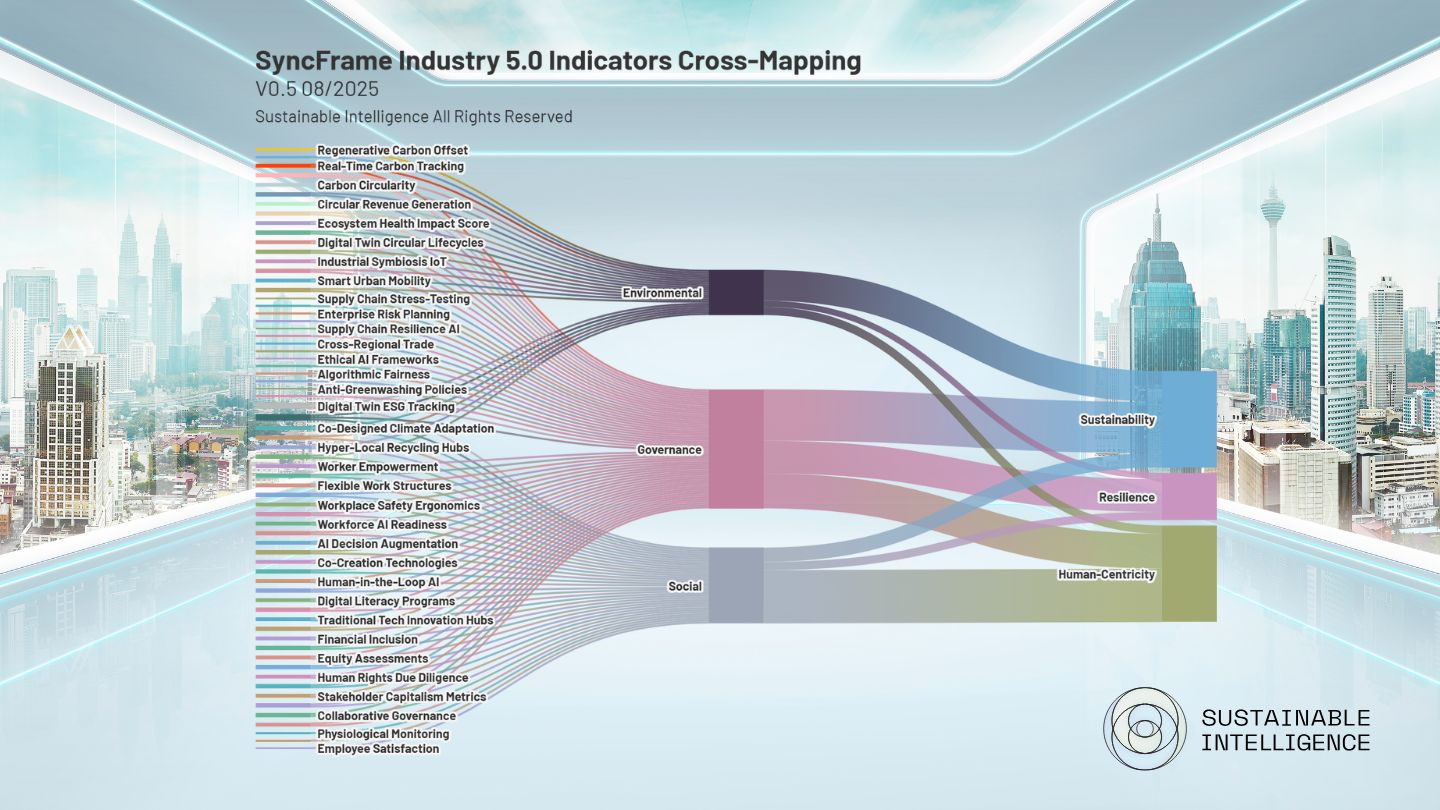
Framework-ready from day one: We bring the Global Sustainability SyncFrame (UN-listed SDG Acceleration Action – Link to UN Website) as the project’s common methods layer—cross-mapped to CSRD/ESRS, GRI/ISSB, EU Taxonomy—for immediate reuse in pilots and exploitation.
-
Assurance-grade AI: Sustin AI, our sustainability-specialised LLM, delivers explainable mappings, evidence trails, and privacy-preserving analytics (incl. synthetic data generation) to meet the call’s compliance and data-quality ambitions.
-
Industry 5.0 focus: Human-centric, resilient deployments with SMEs in the loop—aligning with EU policy and the AI/Data & Robotics Partnership expectations.
What we will build (Innovation Action)
-
Reference architecture for compliant ESG/impact data spaces (governance, interoperability, vocabularies, policy enforcement).
-
Compliance-by-design toolchain: ingestion → validation → framework mapping → evidence binder → multi-framework outputs; GDPR/AI Act guardrails.
-
Privacy tech & synthetic data to improve data fitness while protecting confidentiality.
-
Demonstrators (TRL 6–7): two to three verticals (e.g., manufacturing Scope-3, hospitality water/energy IoT, green-finance underwriting) integrated with existing EU data-space initiatives.
We are seeking partners
-
Industrial data holders: manufacturing, hospitality, logistics/retail, utilities—willing to pilot and share real-world datasets.
-
Platform & data-space players: ERP/PMS/cloud providers; data-space builders; DSSC-connected bodies.
-
Finance & insurers: green-finance use-cases (risk, underwriting, disclosure).
-
Legal/compliance & privacy tech: GDPR/AI Act expertise, PETs, certification bodies.
-
Cities/regions & associations: living labs and multi-stakeholder ecosystems for scale-out.
What’s needed now
To move forward together, we invite potential partners to:
-
Confirm pilot interest by providing indicative datasets and/or test sites.
-
Share a short capability note (including expertise, role in the project, and PIC).
-
Join an alignment call before 25 September 2025 to refine roles, ensure complementarity, and shape the final consortium proposal.
Indicative outcomes
-
Open reference architecture, governance kits, and SDKs for compliant ESG data sharing.
-
Pilot results with measured admin-burden reduction and higher data quality.
-
Exploitation plan to operationalise the toolchain via SyncFrame & Sustin AI, and to align with Common European Data Spaces.
Timeline
-
Consortium formation: August – September
-
Draft & reviews: September
-
Submission: 2 Oct 2025 (single stage).
Next Steps
If your organization is interested in shaping this joint proposal, please contact:
Seph Z. WANG
Founder & CEO, Sustainable Intelligence (SUSTIN)
📧 [email protected] | 🌐 sustainableintelligence.io

Call text (as on F&T portal)
HORIZON-CL4-2025-03-DATA-13
Expected Outcome:The projects are expected to contribute to the following outcomes:
- Easing the compliance process of businesses and professionals with the relevant EU legislation, in particular reporting obligations, and alleviating administrative burdens for businesses and professionals.
- Developing and integrating advanced technologies for data collection, data sharing and data analytics for simplifying and automating compliance.
- Generating, managing, and leveraging synthetic data to improve fitness for purpose; addressing limitations of real-world data, enhancing data quality, diversity, and representativeness, while mitigating bias and addressing other ethical issues.
- Ensuring broad user training and support for rolling out and scaling up “compliance and privacy by design” and the FAIR[1] principles in the constantly evolving regulatory landscape.
Scope:As the European Union (EU) legislation continues to expand, both in the digital (GDPR, Open Data Directive (ODD), Data Governance Act, AI Act, Data Act) and non-digital realm (e.g. green deal, due diligence, healthcare, transport), businesses and professionals face increasing challenges in maintaining compliance. Also, the complexity and volume of reporting obligations are growing, posing difficulties for both regulatory bodies to enforce laws and for entities trying to comply. These challenges underscore the need for innovative solutions to streamline compliance processes and enhance competitiveness within the EU.
Another current challenge are limitations of real-world data such as issues with availability, confidentiality, and bias. Synthetic data is becoming increasingly vital in addressing these problems. By generating and utilizing synthetic data, actions within this framework aim to enhance data quality, diversity, and representativeness, making it a crucial tool for AI-powered innovation and regulatory compliance.
Where relevant, the actions should address cybersecurity, interoperability, reproducibility and standardization, and/or liaise with other actions working on those aspects, in view of facilitating effective data sharing across platforms and sectors, while ensuring an adequate level of security and protection.
Actions should provide necessary comprehensive user training and support, (also involving the users/stakeholders outside the project), ensuring adaptability and scalability to accommodate evolving regulations and diverse organizational needs and to raise awareness and improve understanding of relevant compliance issues. Proposals for all three areas should analyse and address the real needs of real users and stakeholders, and how these will be addressed in the proposed action. The training and user needs should be linked to tangible progress indicators in the proposal.
The proposal should clearly state (in the abstract and in the introduction) which of the following three areas it addresses. A proposal can address more than one area, but it should indicate one of them as the main focus of the proposal, and it will be evaluated accordingly under that area.
- Area 1: Actions to develop advanced compliance technology integrating AI, cybersecurity, language technologies, and privacy preservation. This framework could include the creation of NLP[2]-driven semantic analysis tools for deciphering complex legal texts and translating them into clear compliance tasks, energy-efficient neuromorphic approaches and mechanisms for optimising massive data operations, or machine learning algorithms trained on historical data to predict and mitigate potential compliance violations. With the capability to detect changes in EU legislation, these advanced AI systems and analytics tools will provide deep insights into compliance performance, risk management, and help forecast upcoming regulatory trends to strategically prepare for future requirements. For usability, it is also important that the tools can be integrated with the organisation’s existing processes and systems.
- Area 2: Actions to ensure auto-compliance of data transactions and data spaces with applicable regulation (e.g. data and sectoral legislation). Actions in this area should anticipate compliance tasks within the context of Common European Data Spaces and coordinate with them as necessary. Actions in this area are expected to develop automatic or semi-automatic tools that analyse and take into account the specific architecture, governance model, exchange mechanisms, tools, data types, identity management, smart contracting, user policies and other user needs or operational features of the actual data spaces, liaising with and building on other actions working in this area, in particular the Data Spaces Support Centre.
- Area 3: Actions to generate, manage and leverage synthetic data in order to improve data quality, availability, representativity, fitness for purpose and compliance. The actions should in particular address the inherent shortcomings of real world data that would necessitate synthetic data (e.g. data availability, confidentiality, privacy protection, enhancing quality, diversity, representativeness, bias). Additionally, actions may target generating synthetic data for sparse or unusual domains, integrating synthetic and real data effectively, or advancing technological capabilities in generative models and simulation-based approaches to drive synthetic data generation forward and/or addressing or modelling rare events and complex dynamic systems. All actions under this Area are expected to address the evaluation, validation and benchmarking of synthetic data to ensure fitness for purpose and safe, ethical and compliant use of synthetic data, including the analysis and mitigation of biases inherited from the original data or introduced by the synthetic data generation process. For these purposes, collaboration with simulation/digital twins actions could be explored.
This topic implements the co-programmed European Partnership on AI, Data and Robotics.
Projects are expected to develop synergies with Digital Europe programme topics implementing Common European Data Spaces, especially the Data Spaces Support Centre (DSSC). Projects are expected to ensure complementarities with projects funded under the following topics:
- HORIZON-CL4-2024-DATA-01-01 AI-driven data operations and compliance technologies (IA).
- HORIZON-CL4-2021-DATA-01-01 Technologies and solutions for compliance, privacy preservation, green and responsible data operations (RIA).
In this topic the integration of the gender dimension (sex and gender analysis) in research and innovation content is not a mandatory requirement.
[1] FAIR: Findable, Accessible, Interoperable and Re-usable data
[2] NLP: Natural Language Processing
Image credit: Horizon Europe – European Commission